
RESONANCE
RESONANCE: Echoes Across Time, Place, and Practice
Resonance is about what lingers.
It is the vibration that remains after an action, the emotional or physical echo of a moment, a place, a memory, or a voice. For artists, resonance is often less about what is immediately visible and more about what is felt — what stays with us long after we encounter a work.
As we launch RESONANCE, our UK-wide open call in partnership with Fabrica, we invite artists to reflect on how this idea has shaped artistic practice across time, and how it might shape their own.
Resonance as memory and absence
Many artists have explored resonance through memory — especially where something, or someone, is no longer present.
Christian Boltanski built an entire practice around absence and remembrance. His installations of clothing, photographs, and dimly lit spaces resonate with lives lived and lost, particularly in relation to collective memory and trauma. The work doesn’t tell a single story; instead, it allows memory to hum quietly in the background, asking viewers to bring their own experiences into the space.
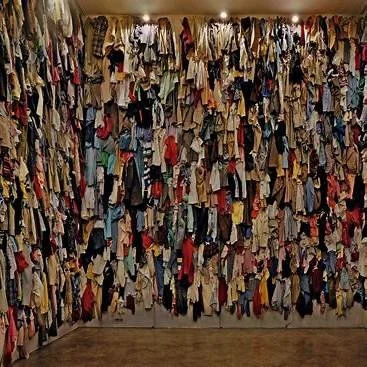
Christian Boltanski
clothing accumulation installation
Similarly, Rachel Whiteread gives form to negative space — the inside of rooms, the underside of furniture, the hollow where something once existed. Her casts are resonant objects: they hold the imprint of human presence without showing it directly.
Resonance and place
Place can resonate long after it has changed.
Artists like Anselm Kiefer engage deeply with landscape as a site of historical and emotional reverberation. His monumental works carry the weight of German history, myth and memory — the land itself becoming a witness to what has occurred upon it.
Closer to home, Tacita Dean often works with specific locations, fragile processes and disappearing technologies. Her films and drawings resonate with time passing, loss, and persistence — the quiet poetry of things on the edge of vanishing.
For artists responding to Resonance, place might mean a building, a coastline, a childhood home, a workplace, or a community — somewhere whose influence still vibrates through the work.
Emotional and psychological resonance
Some works resonate not because of what they depict, but because of how they make us feel.
Mark Rothko believed painting could create a direct emotional encounter. His colour fields are often described as immersive or enveloping — works that resonate inwardly, inviting contemplation, grief, or stillness. The resonance here is internal, subjective, and deeply personal.
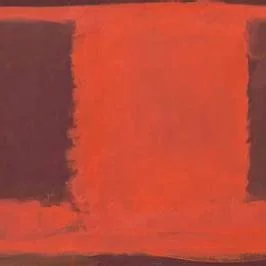
Mark Rothko – Seagram Murals
Likewise, Louise Bourgeois used repetition, scale and symbolism to explore emotional memory, particularly around family, trauma and the body. Her sculptures and drawings resonate with psychological intensity, often returning to the same forms again and again, like thoughts we cannot quite let go of.
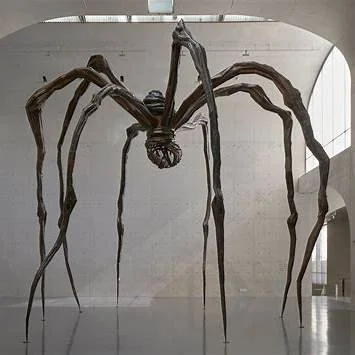
Louise Bourgeois – Maman
Few contemporary artists have explored emotional resonance as powerfully as Tracey Emin, whose work often draws directly from lived experience — love, longing, shame, grief, desire and survival. In pieces such as My Bed (1998), Emin transforms the personal into something collective, creating an artwork that resonates not through spectacle but through raw presence: the trace of a life, a moment, a crisis, an aftermath. Whether through neon texts that read like private thoughts made public, or sculptural works that feel like small memorials to feeling, Emin reminds us that resonance can be intimate, unresolved, and enduring — the echo of something real that continues to live in the body and in memory.
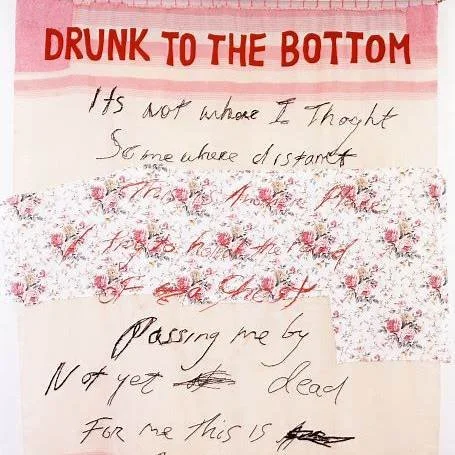
Appliqué blanket Drunk to the Bottom of My Soul, Tracey Emin
Sound, repetition and vibration
Resonance is also literal.
Sound artists such as Janet Cardiff and Susan Philipsz use audio to activate spaces, creating experiences that unfold through echoes, reverberation and movement. Philipsz’s Turner Prize–winning work transformed public environments using the human voice — sound lingering in air, architecture shaping how it is heard.
In visual art, repetition itself can create resonance. On Kawara’s date paintings mark time passing through persistent return. Each painting resonates not only individually but as part of a lifetime-long act of recording existence.
Contemporary resonance: social, political, digital
Today, resonance can also describe how images, ideas and events circulate.
Artists working with archives, digital media, protest imagery or social histories often explore how moments ripple outward — how they are remembered, misremembered, shared, and reactivated. Resonance might lie in a repeated gesture, a shared symbol, or a story that refuses to fade.
Your response
For this open call, Resonance is intentionally open-ended.
You might explore:
emotional or personal resonance
the resonance of place, history or community
material resonance — texture, sound, repetition
cultural or political echoes
what persists, returns, or refuses to disappear
Abstract or figurative. Quiet or bold. Intimate or monumental.
As we celebrate and relaunch Fabrica’s exhibition legacy, we invite artists to add their own voices to this ongoing echo — contributing work that resonates now, and continues to resonate into the future.
Submit your work
Resonance is now open for submissions. The entry fee is £20 per artwork, and artists may submit up to 3 works. Once your entry has been received, you’ll be sent a link within 48 hours to our closed Artist Page, where you’ll find full submission guidance, pricing information, and a direct link to the submission form.
Please check your junk/spam folder if the email doesn’t appear in your inbox.
Deadline for submissions: 15th March 2026 23:59
PURCHASE YOUR ENTRIES HERE
We recommend entering early to avoid missing out.