
# Shelter Through Art A companion piece to Episode Two of The Sussex Contemporary Podcast
As we build towards THE SUSSEX 2026, our open call themed around Shelter, I wanted to take a closer look at how artists across history have approached the idea — not as a complete survey, but as a journey through a handful of works, each opening a different door into what shelter can mean.
Submissions for THE SUSSEX 2026 close on 30 September 2026. If you'd like the full audio version of this journey, Episode Two of the podcast is where it started life.
Shelter as survival
For early human communities, shelter was bound to survival — protection from weather, animals and danger, found in a cave or built from wood, earth, stone, hide or vegetation. The surviving images from this period are often found on rock itself: hands, animals, signs and pigments turning stone surfaces into places of communication, ritual, memory and imagination. Not every decorated cave was a home, but these spaces bring shelter and image-making into close proximity — a protective enclosure that also became somewhere human experience could be recorded and shared.
As settlements developed, shelter became bound up with identity, community and power. Walls didn't just hold up a roof — they established boundaries. What was inside and outside. Public and private. Protected and exposed. Those questions — who possesses the land, who controls the entrance, who is welcomed in, who is kept out — have followed the idea of shelter ever since.

Caught in the weather
Utagawa Hiroshige, Sudden Shower over Shin-Ōhashi Bridge and Atake, 1857
A dark cloud hangs across the sky. Rain cuts diagonally through the image in long, forceful lines. On the bridge below, people hurry through the downpour with hats, umbrellas and straw coverings that offer only partial protection. This isn't a permanent home — it's shelter as an immediate bodily need, portable and provisional: whatever can be carried, worn or held above the head. The image captures how quickly the boundary between security and vulnerability can shift.
See it at the Yale University Art Gallery (high-resolution IIIF image available): https://artgallery.yale.edu/collections/objects/49568
A room of one's own
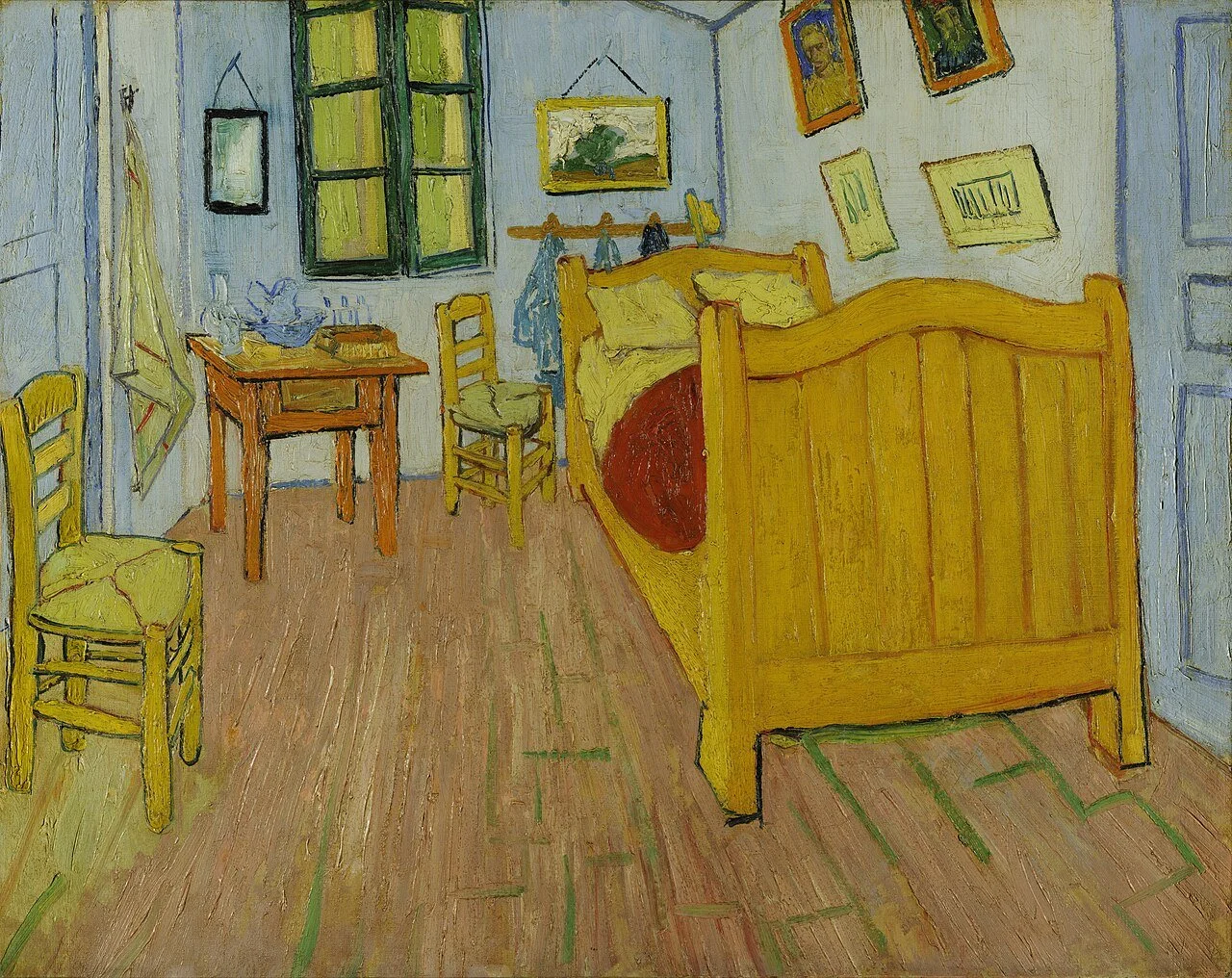
Vincent van Gogh, The Bedroom, 1888
Van Gogh painted this three times. There's a wooden bed, two chairs, a small table, pictures on the wall — simple, not luxurious, but his. He wanted the painting to communicate rest. But the perspective is slightly unsettled — the walls and floor seem to tilt. Knowing about the periods of instability in his life, it's tempting to read the room as both sanctuary and psychological space: a place of desired rest that doesn't feel completely secure. Shelter may protect the body while the mind remains restless.
The first version lives at the Van Gogh Museum, Amsterdam: https://www.vangoghmuseum.nl
The second is at the Art Institute of Chicago
The third is at the Musée d'Orsay, Paris
Background and images of all three: https://en.wikipedia.org/wiki/Bedroom_in_Arles
A roof without dignity
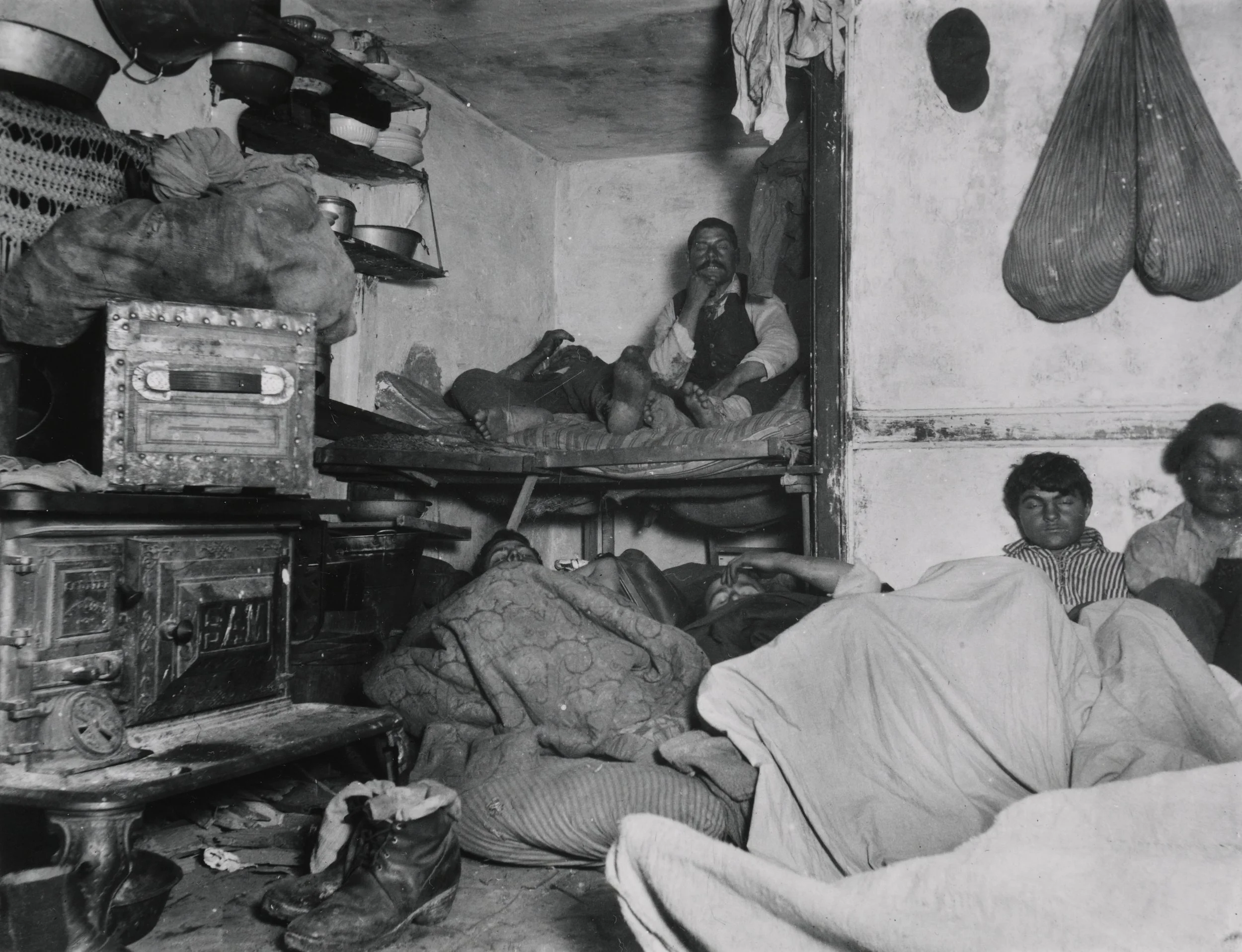
Jacob Riis, How the Other Half Lives, 1890
Riis's photographs exposed the overcrowded, dangerous conditions many poor and immigrant residents of New York lived in. These images complicate any romantic idea of home — a roof doesn't necessarily provide dignity, privacy, comfort or safety. But it's worth looking at this work critically too. Riis entered and photographed vulnerable communities from a position of authority; his images gave visibility to injustice, but also shaped how their subjects were seen by more privileged viewers. Who has the power to represent another person's home? When does witnessing become intrusion?
Read the full digitised 1890 edition at the Library of Congress: https://www.loc.gov/item/04011775/
Free ebook edition via Project Gutenberg: https://www.gutenberg.org/ebooks/45502
Shared space, collective vulnerability
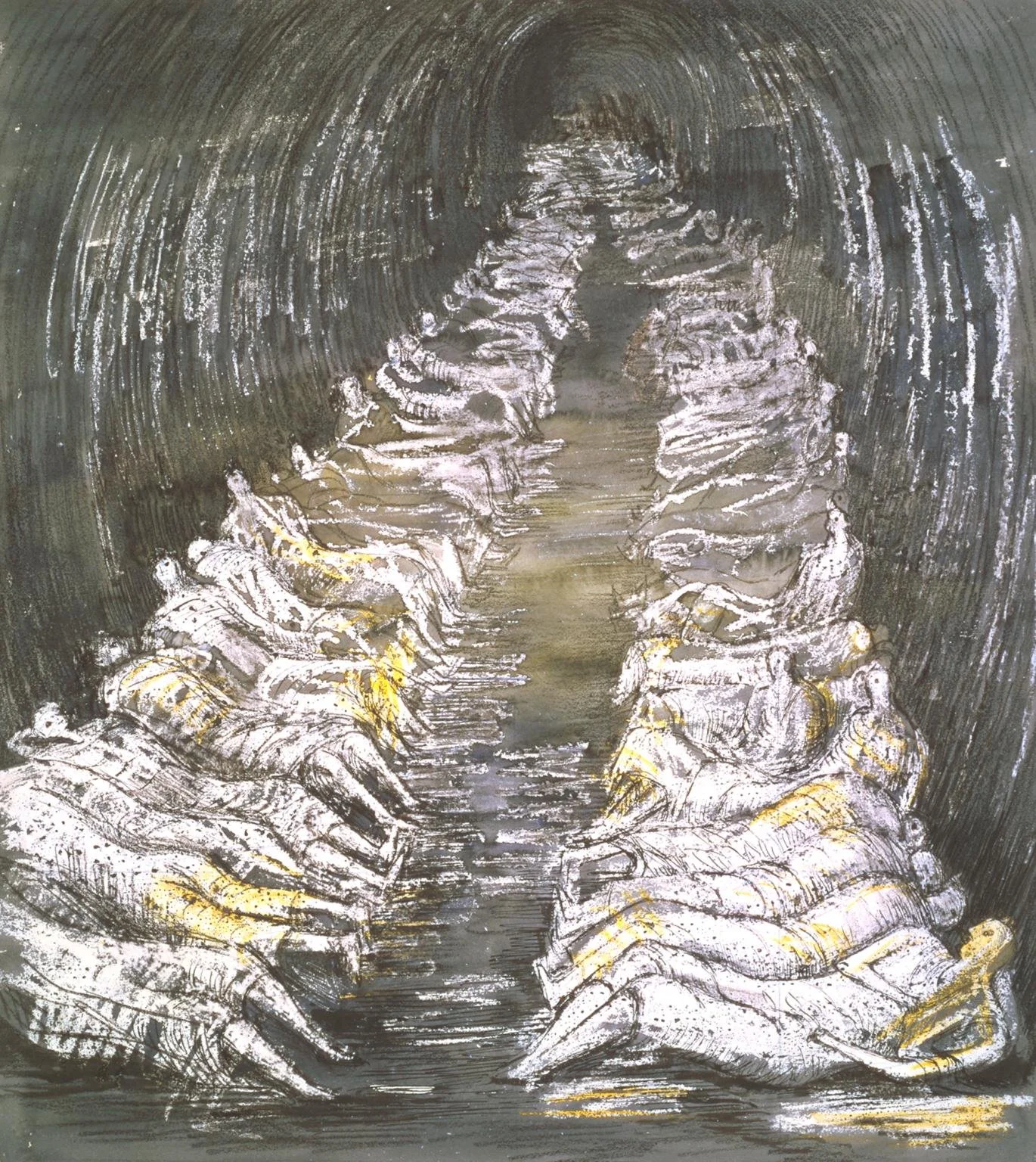
Henry Moore, Tube Shelter Perspective, 1940–41
During the Blitz, Moore drew people taking refuge from bombing in London Underground stations. Rows of figures lie close together beneath the city; individual identities are hard to distinguish; blankets cover bodies; the tunnel stretches into the distance. A station designed for transport was transformed by necessity into somewhere to wait, rest and survive. Privacy disappears. Moore's drawings reveal an important distinction: shelter may offer protection without offering comfort. Safety can be temporary, crowded and frightening — surviving the night rather than feeling at home.
The Henry Moore Foundation's catalogue of the Shelter Drawings: https://www.henry-moore.org
Background on the artist: https://en.wikipedia.org/wiki/Henry_Moore
Cutting the home open
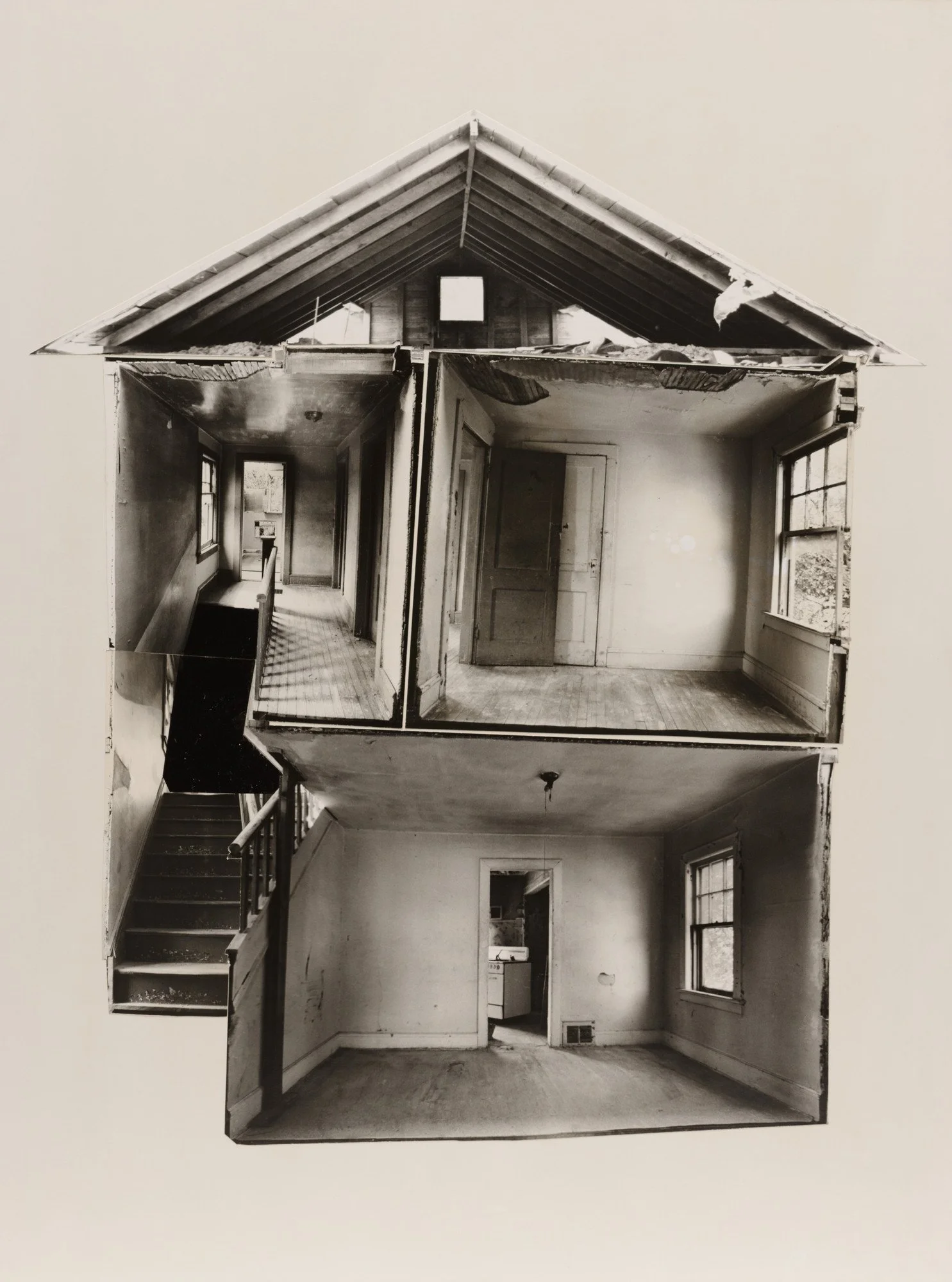
Gordon Matta-Clark, Splitting, 1974
Matta-Clark cut through an ordinary suburban house in New Jersey, dividing its structure and opening it to light — disrupting one of the most familiar symbols of stability, the family home. Its interior was exposed, its apparent solidity made temporary. The work asks us to look at architecture as something shaped by economic and social forces rather than as a permanent, neutral container. The security a home represents depends on systems of ownership, money and power.
Documentation photograph/collage in the collection of the Spencer Museum of Art, University of Kansas: https://spencerart.ku.edu/art/collections-online/object/18358
Home as memory, made material
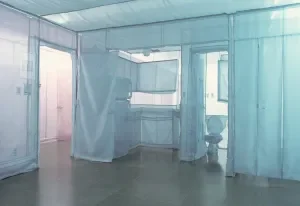
Do Ho Suh, 348 West 22nd Street, Apartment A, New York, New York 10011, 2000 onward
Do Ho Suh recreated a former New York apartment at full scale using translucent nylon — doors, corridors, windows and architectural details carefully reproduced in fabric. The apartment is present, but ghostlike; light passes through it; it can be folded, transported and reconstructed elsewhere. Does home disappear when we leave a place, or remain within our memories, shaping us still? Here, shelter becomes portable — not as a tent or temporary dwelling, but as memory made material, an architecture that can travel with the person who remembers it.
A component piece (Radiator, Corridor/Ground Floor) is held at the Smithsonian American Art Museum: https://americanart.si.edu/node/58886
Suh's related work has been shown extensively at Tate Modern, including the major 2025 survey Walk the House: https://www.tate.org.uk
When home becomes dangerous
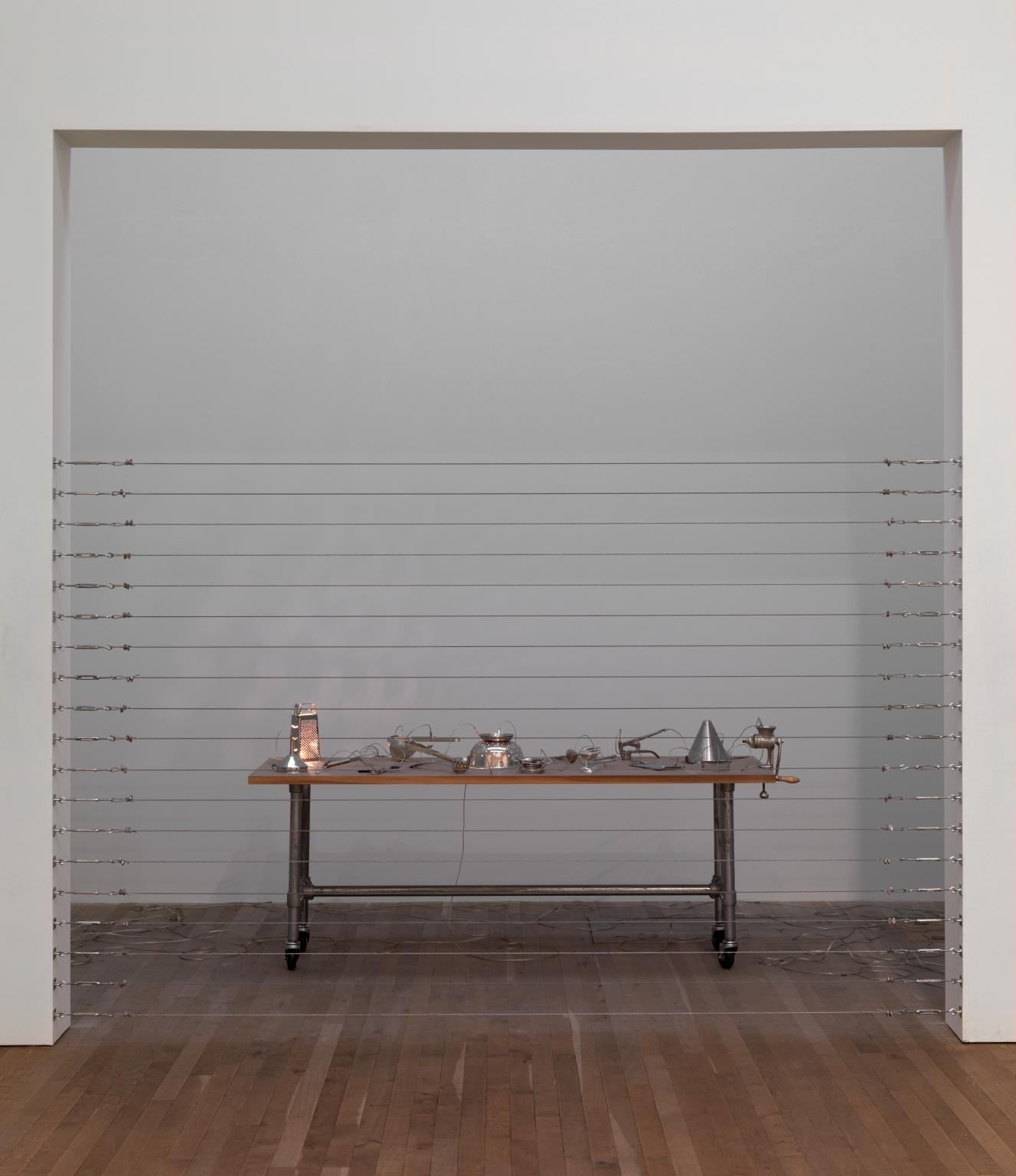
Mona Hatoum, Home, 1999
Hatoum uses familiar domestic objects but strips away their reassurance — household items connected by electrical wires, placed beyond a barrier. The title promises safety; the experience of the work undermines that promise. Hatoum was born in Beirut to a Palestinian family and became stranded in Britain when civil war in Lebanon prevented her return. Across her practice, familiar objects and spaces often become unsettling, raising questions about displacement, conflict and control. Shelter is no longer automatically a sanctuary — the domestic space can contain danger, become unstable, unavailable, or impossible to return to.
Mona Hatoum's major UK survey was held at Tate Modern, touring from the Centre Pompidou, Paris: https://www.tate.org.uk
Background on the artist: https://en.wikipedia.org/wiki/Mona_Hatoum
Where this leaves us
Shelter has moved, across these works, from survival to settlement, from private room to shared refuge, from physical structure to memory. Hiroshige showed people caught in a sudden change of weather. Van Gogh turned a modest bedroom into a portrait of rest and inner life. Riis exposed inequality hidden behind the walls of a rapidly growing city. Moore recorded collective refuge during war. Matta-Clark cut through the apparent stability of the suburban home. Do Ho Suh transformed an apartment into a portable memory. Hatoum made the familiar domestic environment feel dangerous and out of reach.
Today, shelter is inseparable from some of the most pressing questions we face: housing insecurity and homelessness, migration and displacement, war and persecution, rising costs and unequal access to land, extreme weather and environmental destruction. It's never only a roof. It's physical and emotional, private and political, permanent and temporary — shaped by who we are, where we've come from, and what the world allows us to call home.
THE SUSSEX 2026 welcomes artists and makers from all disciplines with a meaningful connection to the UK. Submissions close 30 September 2026.
Jo Myles is founder and creative director of Sussex Contemporary